
Clay County Projected Release Meaning
A projected date is an agency forecast based on the information then in the record. The actual release date is the day the responsible custodian records the person’s departure. Mississippi Department of Corrections uses the exact public field label Tentative Release Date. It should not be renamed as a guaranteed release date.
A Clay County pretrial detainee usually has no calculated sentence-release date. Bond, dismissal, plea, trial, a court order, or transfer may determine what happens next. A person serving a local sentence needs the court judgment and the Clay County Detention Center’s calculation. A state prisoner’s computation belongs to MDOC.
Custody can also pass straight to another agency. In that event, release from Clay County Detention Center is not release to the community. The receiving custodian and court record are needed to explain the handoff.
Find Clay County Projected Release Dates
The first task is to identify the custody type. MDOC is the proper source only for a Mississippi state sentence or state community-custody record. A routine Clay County booking that never became an MDOC sentence will not gain a useful state computation merely because the person spent time in the county detention center.
- Check the custody source. Separate Clay County jail custody from an MDOC state sentence, federal custody, or another agency’s hold.
- For an MDOC case, open the MDOC inmate search and search by exact name or MDOC ID.
- Match the result through the MDOC ID and basic identifiers. Then open the detail record.
- Read Location, Unit, Location Change Date, sentence rows, and the exact Tentative Release Date field together.
- For Clay County pretrial or local-sentence custody, request the court order and ask the jail for the public calculation or release record.
A current roster answers whether a person is shown in custody now. It does not calculate an exit. The Clay County sheriff’s short release feed can confirm a recorded departure after it occurs, but it omits the reason and destination. The Clay County released inmate records path covers the jail docket and court sources for that later confirmation.
Clay County MDOC Release Fields
The MDOC result must be read as a complete record. Its public fields include Entry Date, Location, Unit, Location Change Date, Number of Sentences, Total Length, and sentence rows with the offense, sentence length, county of conviction, and sentence date. The detail page also displays a photograph and Tentative Release Date.
| MDOC field | How it helps | Limit |
|---|---|---|
| Location and Unit | Shows the recorded custody or community placement | A community unit can remain under MDOC jurisdiction |
| Location Change Date | Dates the latest displayed move | Does not state final discharge by itself |
| Sentence rows | Connects the computation to sentence data | Public rows are not the full timesheet |
| Tentative Release Date | Shows MDOC’s current projected date | It may change and is not the actual exit event |
The MDOC detail layout demonstrates the precise label used for the date.
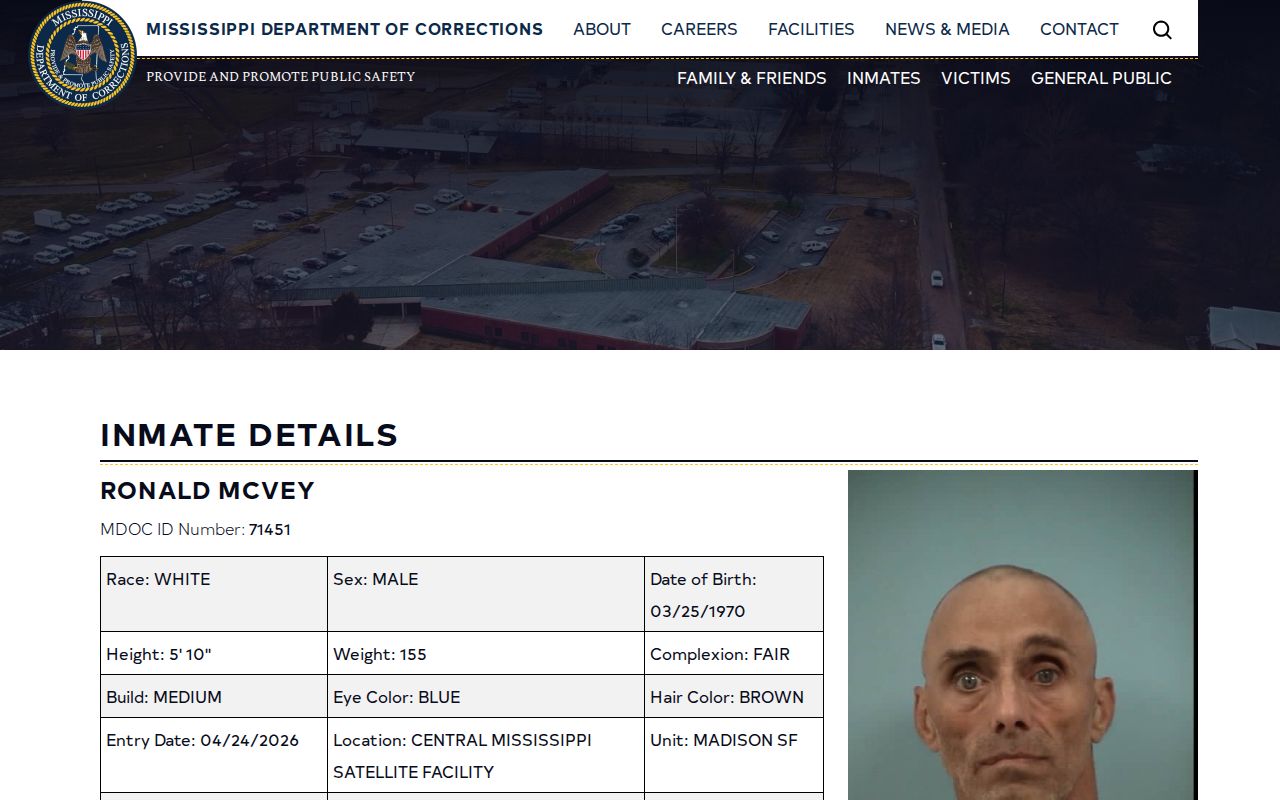
The image illustrates the field arrangement. It should be used to understand labels, not to draw a conclusion about an unrelated individual.
Clay County Earned-Time Release Rules
Mississippi’s earned-time baseline appears in Miss. Code § 47-5-138 legislative text. Earned time can affect MDOC computation, but it is not a simple coupon taken off every sentence. Offense exclusions, mandatory minimums, classification, behavior, forfeiture or restoration of credit, verified pre-sentence credit, and sentence changes can all control the result.
The familiar 85/15 statement is not universal. MDOC explains that for applicable crimes on or after July 1, 1995, a person may be required to serve 85 percent in a facility and may be eligible to serve the remaining 15 percent on Earned Release Supervision. “May” matters. The rule does not promise release at the 85 percent point, and later reforms or offense-specific limits can lead elsewhere.
MDOC’s supervision types explains ERS and related community statuses. The source image shows the agency’s own context for that framework.

ERS continues inmate status and MDOC jurisdiction. It is community placement, not a discharge certificate, and a violation may result in return to a facility.
Note: Do not subtract a percentage from a Clay County sentence and announce a release date without MDOC’s verified computation.
Clay County Parole Eligibility Dates
Parole eligibility and a projected release date answer different questions. Eligibility means the State Parole Board may consider a person under the controlling law. It is not a grant, entitlement, or actual release date. Miss. Code § 47-7-3 contains branches based on the offense, offense date, sentence, and exclusions.
Official rules summarize some post-1995 categories with different fractions and caps: qualifying nonviolent cases may use 25 percent or ten years, specified violent cases 50 percent or twenty years, and armed robbery, drive-by shooting, or carjacking 60 percent or twenty-five years. Certain qualifying nonviolent, nonhabitual controlled-substance convictions may follow the 25 percent or ten-year category. Broad exclusions and Board discretion remain.
Those categories are not a tool for a do-it-yourself computation. Earned time does not simply reduce the minimum parole-eligibility service required. The full judgment, the date and statute for each offense, current law, and the official agency calculation control. A parole denial or later hearing can leave the tentative MDOC timeline in place or change the practical path to release.
Clay County Jail Credit Verification
Time spent in Clay County custody before sentencing may enter an MDOC calculation only when it is attributable to the current cause and falls within the qualifying period. MDOC can ask Clay County, as the county of conviction, to verify that credit. The public detail page does not expose the full underlying timesheet.
For questions about credit, the inmate and case manager should compare the timesheet, judgment, and eligible pre-sentence days. Family members and researchers should not count calendar days from a booking card and treat the result as official. Another charge, an unrelated hold, an amended sentence, or a gap in qualifying custody can make that arithmetic wrong.
A locally sentenced person is different. The court and Clay County Detention Center hold the relevant local judgment and calculation. No complete Clay County policy was verified for a public worked example, so a precise local date must come from those records rather than a generic good-time formula.
Clay County ERS Release Dates
An ERS date marks a possible move into Earned Release Supervision, not the end of the state sentence. MDOC retains inmate status and jurisdiction after the person leaves a secure facility for that approved community placement. The public record may show ERS as the Location or Unit, which is evidence of continuing state control in the community.
Residence approval can affect the timing of that move. Classification, verified credits, offense exclusions, legal holds, and MDOC discretion can also prevent the public tentative date from becoming the date of community placement. Once on ERS, failure to follow the controlling requirements can lead to a return to a facility. The state record should therefore be checked both before and after the expected change.
Final discharge requires stronger proof. Seek the discharge certificate or an MDOC record that confirms the discharge date and status. A past Tentative Release Date is not enough. Nor does an ERS location show that jurisdiction has ended. These distinctions are especially important when the question concerns a Clay County resident who has returned to West Point but still answers to MDOC Community Corrections.
Why Clay County Release Dates Change
A date can move when the legal facts or agency records change. Some factors alter the sentence computation. Others prevent a planned departure even when the underlying term is near its end. The source of the change determines which office can explain it.
| Factor | Possible effect | Confirm with |
|---|---|---|
| Credit correction | Verified jail time or earned time changes the calculation | MDOC case manager or time computation record |
| Discipline or classification | Earned credit may be forfeited, restored, or limited | MDOC record and authorized agency response |
| Sentence amendment | A later court order changes the controlling term | Sentencing court and MDOC |
| Detainer or hold | Another agency may take custody at departure | Holding and receiving agencies |
| Parole decision | A grant, denial, revocation, or later consideration affects the release path | Parole Board or MDOC action |
| ERS residence approval | Community placement may wait on an approved plan | MDOC Community Corrections or case manager |
A past tentative date is a signal to check, not proof that the person left. Review the current Location and Unit, newer sentence rows, credit updates, and any transfer or supervision event. A detainer can turn a release from one custodian into immediate custody by another.
Confirm Clay County Actual Release
MDOC says the case manager communicates exact release information. Its process can take 30 to 45 days, and the inmate must receive a discharge certificate before release. Those facts explain why a public tentative date should not be treated as a promise or used alone to schedule an arrival.
The agency computes several dates for different legal purposes, including parole, ERS, tentative release or discharge, and maximum release. They need not match. The public search also does not expose every credit decision, hold, or processing step behind them. A focused question to the case manager should identify the date label at issue and ask what can be confirmed from the current computation.
The MDOC release FAQ describes computation questions and the discharge-certificate process. The captured source gives a direct view of that official guidance.

For an upcoming state release, use the case manager and MDOC record. For a past event, request the public discharge date, certificate, or other available discharge record. For a county release, use the sheriff’s affirmative release feed while it remains online, then the jail docket and release authority.
MS SAVIN/VINE can add a recent release or transfer alert for a matched person, but it reports the source agency’s event rather than a certified historical release date. The Clay County VINELink check explains the one-person match and notification route. Always keep the reporting custodian attached to the result.
Note: Actual release is confirmed by the responsible custodian’s event or discharge record, not by a forecast that has merely passed.